Showing posts with label penwerkz. Show all posts

Monday, June 10, 2024

National Ballpoint Day ! (Newest Acquisitions ~ Virtual "Show & Tell" - part 519)

Happy National Ballpoint Day! Although we're primarily a fountain pen club, we've had meeting themes that included ballpoints (modern and vintage), so today I thought I'd feature some modern handcrafted ballpoints I acquired in the last year. All of the ballpoints use a twist-action mechanism, but some take Cross refills and some take Parker-style ones. One interesting thing about them is that nearly all are made of unusual materials. Intrigued? Read on!

(all photos by Maja ~ please click on image to enlarge)
The ballpoints above were all made by Dylan Swain of The Pen Den (in Gatineau, Quebec), who uses a variety of materials in pen production. Among these are pen blanks he creates himself (using a resin 3D printer) from 3D-printed molds filled with colourful resins and glittery mica powder. Examples of pens made with these blanks are the bottom three ballpoints in the photo above - (top to bottom) "Another Dimension", "Chromatic Wavefront" and "Rainbow Harmonics".

The gorgeous ballpoint at the top --the aptly-named "Wood and Waves"-- was created from a maple burl/blue resin hybrid blank. The material was polished to a mirror-like finish and it's one of the nicest ballpoints I own (although I really like the bright colours & playful designs of the 3-D mold/resin pens). As a little bonus, Dylan often includes a LEGO minifig (such as the one above) with the pens he sells :)

(Above: "Chromatic Wavefront" ballpoint by The Pen Den)

The newest acquisition in this blog post--my "Rainbow Harmonics" ballpoint by The Pen Den (love the purple metal trim!)


This stunning ballpoint was created by Jeff Hattrup of Rustic Star Woodworks in Texas. It uses Parker/Parker-style refills and is made of a very interesting material called Fordite...

So, what is Fordite? I'll let my friend Wikipedia explain - Fordite is "a lapidarist term for polished pieces of finely-layered paint masses from automobile factories. The masses consist of automotive paint which has hardened sufficiently to be cut and polished. It was formed from the buildup of layers of enamel paint slag on tracks and skids on which cars were painted with acrylic lacquer, which have been baked numerous times." Many different Fordite paint colour combinations were created over the decades; the combos ranged from the muted colours used in 1940s Ford autos, the brighter metallic tones in 50s and early 60s Fords, to the wilder colours used in the late 60s and 70s.

Since Ford now uses a different paint processes (one that doesn't result in paint overspray), there isn't any more genuine Fordite being made, so prices for it are going up. Fordite is also difficult to turn on a lathe, so that adds to the price of the finished pen. In case you were wondering, I don't know which particular Ford model used the paint colours in my ballpoint's Fordite, but I know it wasn't the 1954 Ford Mercury Sun Valley model (vintage car buffs -- forgive me for using the wrong model car prop in my photos!). In any case, I think it's neat owning a piece of Ford history via this cool ballpoint :)

From Fordite, we move to SpectraPly, another repurposed material used in pen-making. SpectraPly is a dyed birch veneer laminate material that was used to make old skateboard decks, among other items. I got these two striking SpectraPly ballpoints (above) from Penwerkz, a small pen & bowl maker in Corona, Californa. I'm glad the pens' maker chose not to add any cap bands to the pens -- I love how the SpectraPly "flows" uninterrupted along the length of the pens-- and I appreciate the care taken to line up the wood pattern in the red & black pen.

The bright blue and yellow ballpoint in the upper left of the photo is from Casey of Artisan Alley CA in Red Deer, Alberta, and it's made of a hybrid pine cone/acrylic material.

The model name for this lovely ballpoint is "Golden Skies with Pinecone", and when you see it in bright sunlight, the light really brings out the highly-polished colours of the material. The pen came with the wooden storage box above, branded with the pen maker's logo on the obverse side.

The other three ballpoints in the group photo were all made by Brian Tearne of Tearne Canada Turnings in Ontario. The two pens resting on the red pen pouch were made by Brian using acrylic resins, which are more traditional materials. I normally don't go for really weighty ballpoints, but I loved the orange acrylic and whimsical adornments of the "Bass Fishing" pen, so I couldn't resist buying it. The ballpoint above it (the "Maple Leaf" model) is made of a swirly orange, yellow and dark grey resin called "Burning Embers". All three ballpoints made by Brian use Parker or Parker-style refills.

(Above: the fishing-themed pen's metal trim looks a bit over-the-top, but I think it works here :)

This is the newest pen I bought from Brian, a handsome "Nordic Style" ballpoint made from a hybrid blank consisting of maple burl and epoxy. It's a hefty pen, but I enjoy using it ... and I like staring at the coppery sparkles in the resin which complement the wood and copper-coloured trim so nicely.

Many thanks to all the pen makers for these wonderful handcrafted pens! I hope you have a good National Ballpoint Day today, and don't forget--our June pen club meeting is on Thursday June 20 at the Vancouver Public Library's RENFREW branch (all details here).

(~ Blog post by Maja ~)

Wednesday, May 24, 2023

May 2023 meeting photos - topic: your oldest fountain pen!

Our May meeting was held on the 18th at the Kitsilano branch of the VPL with sixteen members in attendance, including three brand-new members - Felipe, Liz and Ray! Our primary topic was Your Oldest Fountain Pen , and Newest Acquisitions --as always-- was our secondary meeting topic.

I was hoping that Alejandra would be at the meeting as she suggested the primary topic (which we'd previously used back in 2015), but she wasn't so I kicked off the "show & tell" with my old-timer---a vintage Sheaffer #4 Self-Filling fountain pen in black chased hard rubber (a/k/a BCHR--you'll see the term used a lot in this blog post!):

(all photos by Maja ~ please click on images to enlarge)

Sheaffer started producing BCHR "flat-top" fountain pens in 1912. Mine has a few features indicating it's an early example--(a) a Sheaffer nickel-plated clip that says "SHEAFFER-CLIP" (which was only used until 1922; after that, they said "SHEAFFER'S"), (b) an early imprint on its flexy nib that says "SHEAFFER 4 SELF-FILLING", (c) a solid, narrow, spear-shaped feed (not shown) and (d) the barrel imprint below:
The pen's barrel imprint reads: "W.A.SHEAFFER PEN CO.    PAT.AUG.25.08. FORT MADISON, IA. U.S.A.    DEC.10.12-JAN.27-OCT.20-NOV.24.14". The earlier flat tops had patent dates on them, and the earliest ones of those had the company name in a slightly larger font (as my pen has), so the imprint on my barrel is the first block imprint. There's one more barrel imprint (but you can't see it in my photos) -- a "4" stamped on the bottom of the pen's barrel.

Based on all this, I believe my pen was made between 1914 and 1922 (and I'm leaning towards the earlier-to-middle part of that range, because of the early barrel imprint). One last thing---you might be wondering why the pen looks brown and not black; that's because the hard rubber material fades in colour with exposure to light (see article on VintagePens.com). The fading is pretty even on my pen, though, aside from the section area (ie. the area not exposed to light).


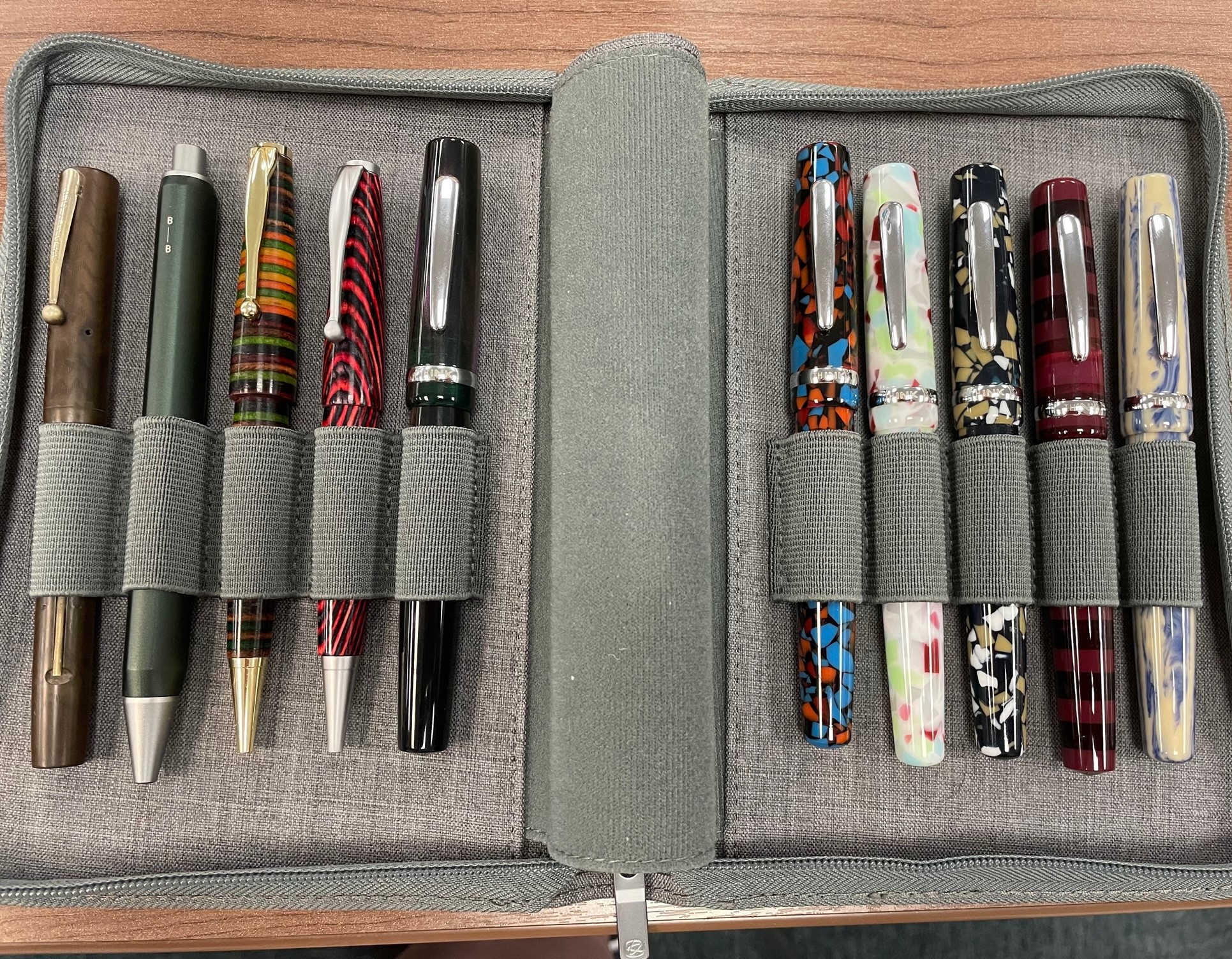
Above: My antique Sheaffer on the far left, with some brand-new pens - (L-R) my Before Breakfast 'Onigiri' ballpoint (reviewed 2 wks ago), two SpectraPly (dyed Birch veneer laminate) ballpoints by California-based Penwerkz, and the six newest additions to my THink writing instrument collection ("Northern Lights", "Yucatan", "Zabaione", "Ascot", "Maldives" and "Lagoon" fountain pens). I was so happy to add these latest THink pens to my collection!


The lovely little rolled gold Sheaffer ringtop fountain pen in the photo above is Stuart's oldest fountain pen. Stuart says its nib imprint also says "SELF-FILLING" and estimates it was made in 1920 or earlier. The other two fountain pens are his Persian Blue Sheaffer 'Tuckaway' (top pen) and Sheaffer 'Sentinel' in Persian Blue .


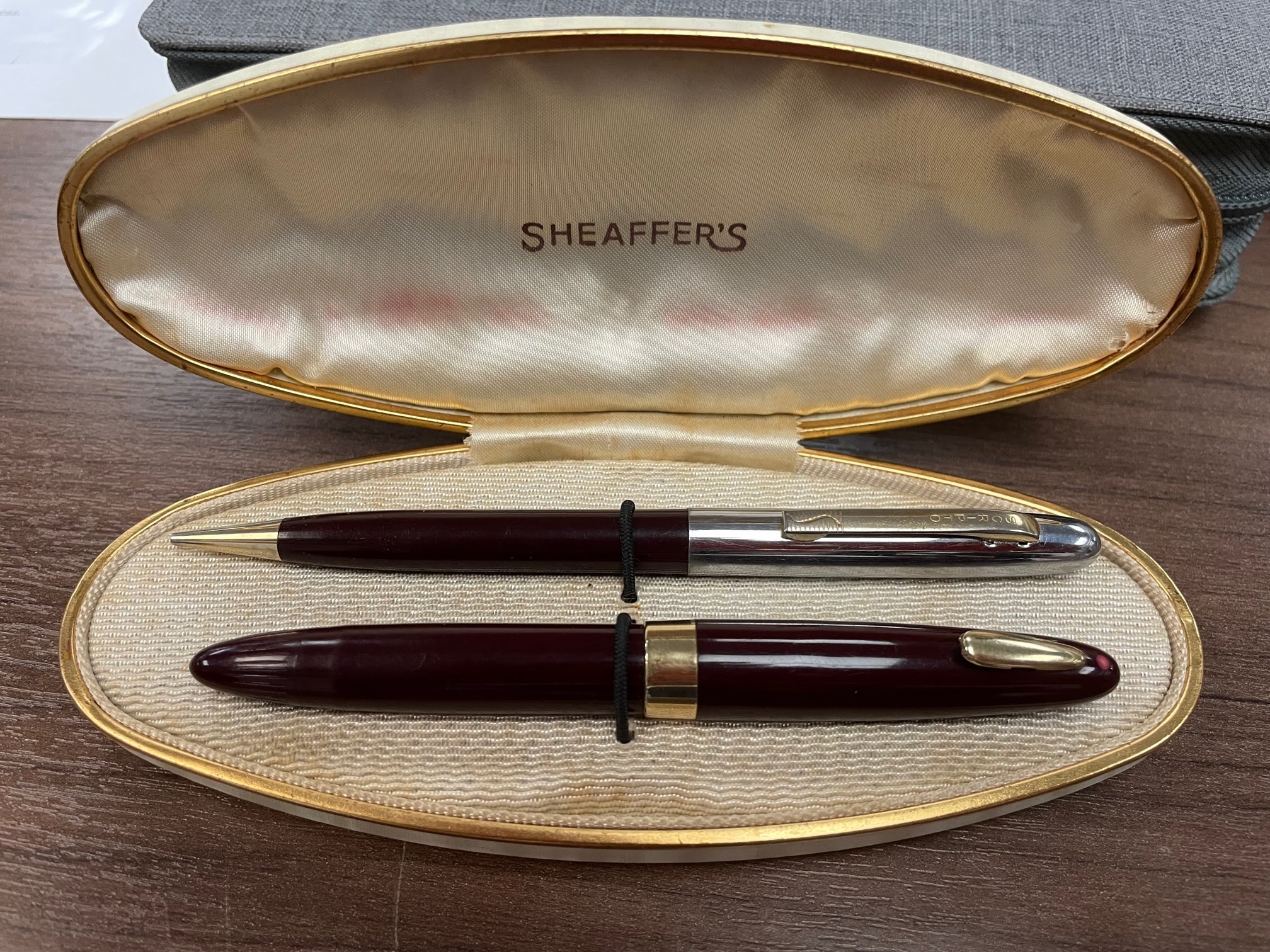
These are Stuart's newest acquisitions --a Scripto mechanical pencil and a Burgundy Sheaffer 'Tuckaway' (ca. 1949, per Stuart) fountain pen. Obviously, they aren't part of the same set, but the Scripto and Sheaffer were sold together on eBay (presumably because they're the same colour) along with the attractive Sheaffer clam shell presentation case.

The 'Tuckaway' fountain pen (on the right, above) has a reddish (ie. not white) dot. I can't find any references to a red dot being used on Sheaffer pens, so I suspect it's an after-market modification (if you know otherwise, please let us know!)

Two different nib styles on Stuart's Sheaffer 'Tuckaways'---the open nib on the Burgundy, and Sheaffer's wonderful conical "Triumph" nib on the Persian Blue version.


Daryl couldn't find his oldest fountain pen (I believe he said it was a Waterman #7!) in time for our meeting but, nonetheless, he brought along some eye candy -- a gorgeous Conklin 'Endura Abalone/Chrome' Limited Edition fountain pen-- for us to see!

The pen was a limited edition Goulet Pens-exclusive model that came out in late 2020 (there's also a version with gunmetal trim, but it's not a Goulet-exclusive). According to Conklin's official website, "The Endura Abalone uses the highly iridescent inner nacre layer of authentic abalone shell from New Zealand." Lovely!


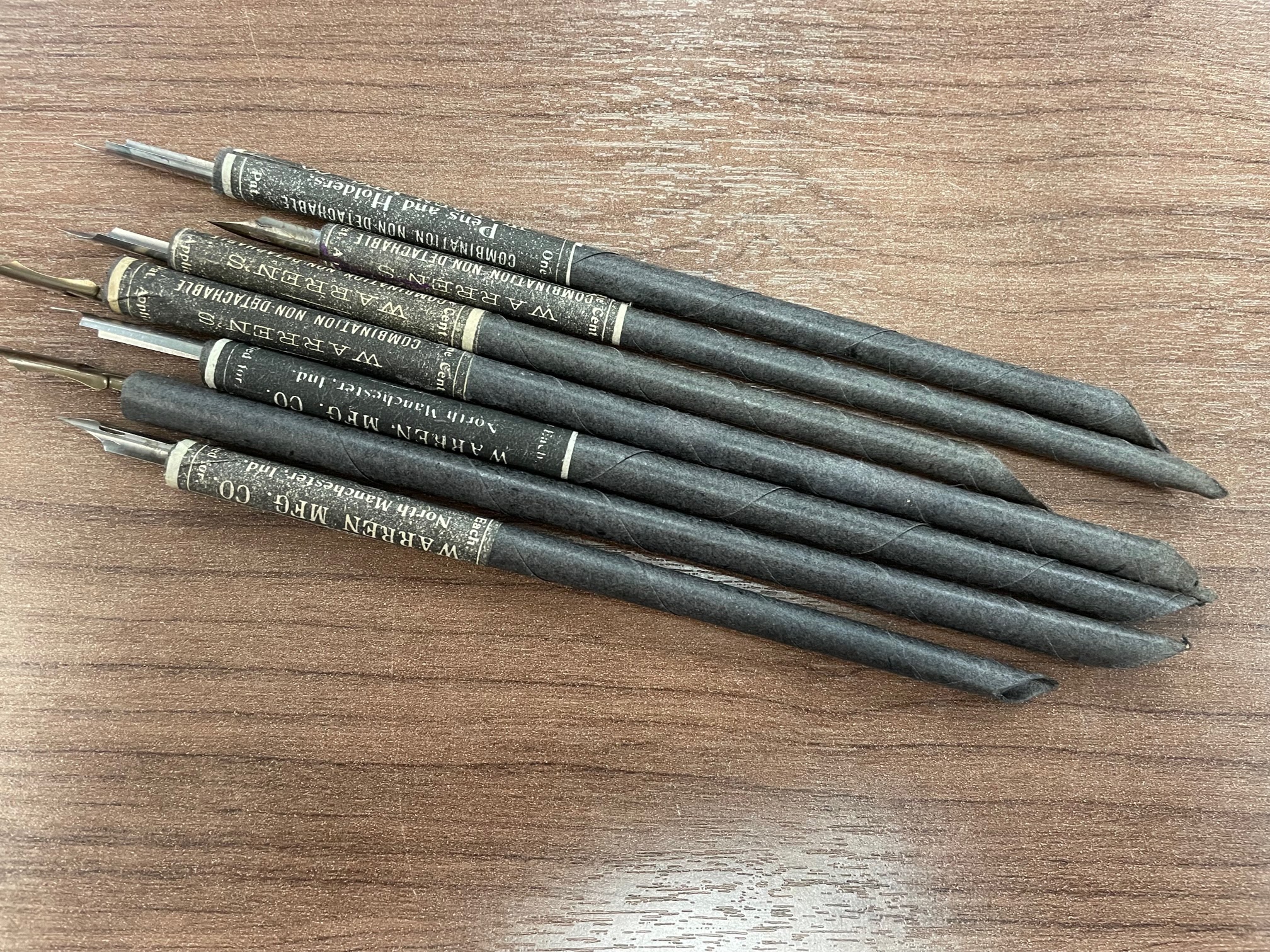
Renz brought some very interesting antique dip pens for us to see! These were made by the Warren Manufacturing Company in North Manchester, Indiana and say "WARREN'S COMBINATION NON-DETACHABLE Pens and Holders" on them. Renz said they date from around 1882 and were purchased at the DC Supershow (the massive pen show held annually in Washington, D.C). Renz does some fine calligraphy work, so I'm glad he found these at the show :)


The dip pen ends were cut at an angle--I'm not sure of the reason, but it does make them look more quill-like...

Above: Some great vintage fountain pens of Renz’s.
From top to bottom: a very valuable Waterman #7 with yellow cap band, a vintage Conklin BCHR Crescent-Filler (with #4 gold nib) and a Wahl BCHR flat top with a wide gold band.

The Waterman #7 fountain pens came with ten different cap band colours--black, blue, brown, grey, green, pink, purple, red, yellow and white. Each band colour corresponded to a different type of nib; in Renz's case, the yellow cap band (which is made of casein) corresponded to a Rounded nib (a firm medium-broad nib with a spherical tip designed for left-handers).

Brand-new member Felipe brought in some of his modern fountain pens, including his wonderful Conklin 'Turquoise Duraflex' Limited Edition (a Goulet Pens-exclusive released in October 2018, only 1898 were made) and a blue Faber-Castell 'Grip' fountain pen (the Conklin is a lovely turquoise colour ---my photos don't do it justice---but the light green background makes it look more green)


Christopher brought in the oldest fountain pen we saw that evening ---his amazing Wirt BCHR with gold overlay; Christopher estimates it was made around 1889.

The lovely box in which the pen was housed did not originally come with the pen, but Christopher said it once held myrrh...


It was Ray's very first meeting and he showed us a nice assortment of vintage pens (many were very recently acquired, so they matched our primary and secondary topics :)
From top to bottom: vintage Parker 'Vacumatic' Major in "Golden Pearl", Sheaffer 'Triumph' model (a "Valiant" ?) in "Marine Green", Parker 'NS (New Style) Duofold' (made in Denmark) in "Chocolate Brown" (I believe it's this colour), and a Waterman red ripple hard rubber fountain pen and pencil set.


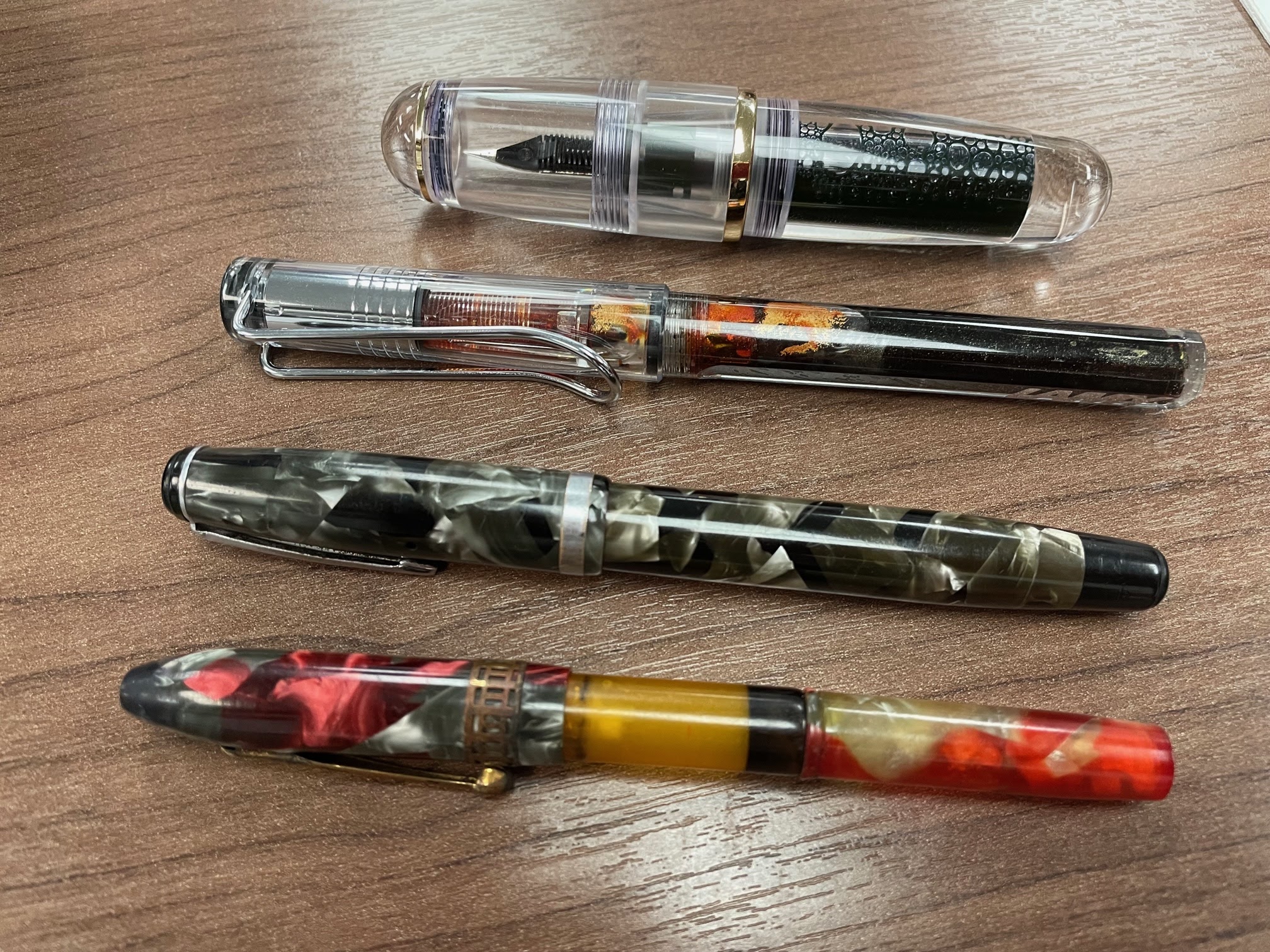
Kelly's oldest fountain pen is the attractive grey marbled Parker 'Challenger" (second from the bottom). She also showed us two clear demonstrator fountain pens she modified--the chunky little Moonman 'Q1' (top pen) and a Lamy 'Vista'. The fountain pen at the bottom of the photo belongs to Ray, and I think it was made by Onward.

So, how did Kelley modify the two demonstrators above? Well, she put a Zebra G nib in the Moonman, and she swapped out the Lamy 'Vista' fountain pen barrel for a 'Vista' rollerball barrel to create an eyedropper-filling fountain pen! (the 'Vista' fountain pen barrel has a cutout so the user can see the ink supply in the ink converter; the rollerball version lacks the cutout)

It's always nice to see older fountain pens belonging to our members' relatives, like the Redipoint rolled gold fountain pen belonging to Phil's great-grandfather, and the Waterman black hard rubber eyedropper-filler with silver overlay that belonged to his great-grandmother. The Redipoint has a lovely inscription on its cartouche that says "Father" in a flowing cursive script :)

The top pen is a new acquisition, also belonging to Phil--a handsome vintage Eversharp 'CA Fifth Avenue' ballpoint. The pen has a very odd refill that doesn't include a metal ball---that part is fixed to the nosecone of the ballpoint-- so the ball draws ink from the refill via capillary action (the "CA" part of the model name). Unfortunately, many refills either dried up or leaked into the barrel which lead to people returning their pens (under warranty), costing the company a lot of money. In fact, this model was known as "the pen that killed Eversharp"


Brand-new member Liz also brought in some great vintage pens--a Parker Vacumatic in "Silver Pearl" (with double striped jewels) and a jet black Conway Stewart '1206'. The pen in the middle is a modern Pilot 'Custom 823' in amber, also belonging to Liz.

The vintage Conway Stewart pen company made a ton of different models but, thankfully, they imprinted the model numbers on them! There's an excellent reference site for old Conway Stewart pens here. On that website, it says that this model was made from 1936-1942 and has 18K gold bands on its barrel.

Isn't Amy's new purple Opus 88 'Omar' fountain pen gorgeous?? I love how the cream-coloured barrel and cap ends complement the purple marbled cap and translucent purple barrel. Amy told us she very recently bought the pen to celebrate her birthday (happy belated birthday, Amy!)

From vivid purple to basic black! These are a couple of fountain pens belonging to Jerred. The top pen is a "Business Line" model made by the German pen company Online (with a very long cap!).

The glossy black fountain pen below it is a Japanese urushi-coated fountain pen. After I posted this meeting report, Jerred emailed me to say that the pen was branded
"Lance", but that the pen's clip said  "Warranted" and its nib was marked "Superior". Jerred added "It's likely a small maker made the barrel and then bought the nib and metal hardware to add on separately.  This was not uncommon."

🌟Jerred also sent me some very interesting information about Japanese gold nibs that I think is well worth reading:

Jerred writes: "The basics about Japanese gold nibs is thus: In the lead up to World War II (and during the conflict) the Japanese government required that citizens turn in gold fountain pen nibs as gold was considered a war resource. Gold doesn't tarnish, and is thus suitable for things like warships where exposed copper wiring contacts would quickly corrode due to exposure to seawater. The nibs were generally replaced with low quality steel or even brass nibs, as iron was also relatively scarce. If someone was found in possession of a gold nib, the pen would be confiscated and the person fined or even sent to work camps. Gold nibs didn't really become popular again in Japan until the American occupation ended in the early 1950s. Nibs made after this point will have a "JIS" mark as well as a number code on them. This was a certification system used by the Japanese government to direct economic growth by only allowing certain companies to legally produce goods in any given industry. The number code with the JIS mark was registered to one maker. Due to this, finding a gold nib on an older Japanese pen that does not bear the JIS marking is quite rare."

Verrry interesting! Thank you to Jerred for that info :)
That's Jerred's new Delta Unica and a vintage Waterman in BCHR belonging to one of our members below it (it might be Ray's Waterman ca. 1903-04, but I'm not sure)

Peter brought in his trusty Pilot Vanishing Point, but I photographed it at our April meeting, and Rene brought in his earliest fountain pen --an Eagle cartridge fountain pen (ca. 1890) that was the world's first cartridge-filling fountain pen!-- but I also photographed it in April. I'm sorry I didn't take a shot of Harold's handsome gold-coloured Diplomat 'Aero' fountain pen, and I really wish I'd snapped a photo of the wonderful vintage fountain pens that Vladan brought; they included: a pre-war Parker Vacumatic Debutante, a Parker Vacumatic Major (ca. 1943), an Osmia that belonged to his father and a vintage Pelikan 400NN (the same model as his father's, but not the same pen). Sorry, guys :(.

Many thanks to everyone who came to our May meeting, whether you brought something for the topic(s) or not; you brought yourself, and that's the most important thing!😊

**I'll post info about our June meeting on this website (it'll be at the top of each webpage, in big red letters) after I confirm the venue and date.

(~Blog post by Maja~)